



Last updated: 6/27/2026
Written by
Takeaways from our panel discussion on OKRs in the age of AI. Plus: our first official release is just around the corner.
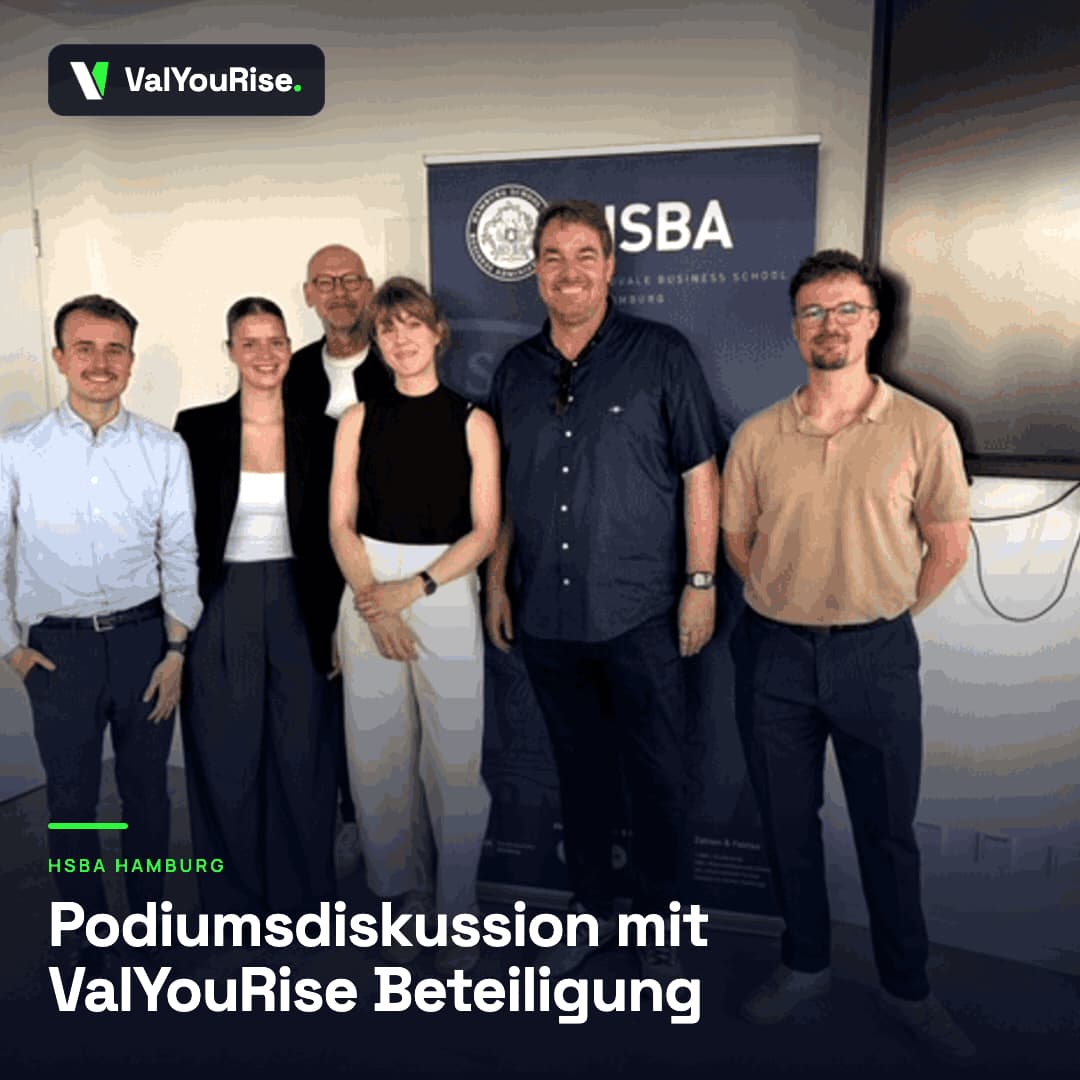
Image: HSBA
Last updated: 6/27/2026
Written by
The theory has been around for more than fifty years. Andy Grove developed the principle at Intel in the 1970s, John Doerr brought it to Google in 1999, and today companies like LinkedIn, Spotify, Amazon, and Adobe run their strategy on Objectives & Key Results. And yet a striking number of companies fail at the rollout, especially start-ups and mid-sized businesses.
That was exactly the question at the heart of our panel discussion at HSBA: Why do so many fail at OKRs when the knowledge has long been available, and how does AI change the picture? The evening was opened by Prof. Michael Höbig and moderated by Kenneth Kross. On the panel were Anna Zeller (consultant at Multiversum GmbH and certified OKR Master), Ulrich Brehmer (Managing Director of HS Hamburger Software), and Dr. Willms Buhse (founder of the management consultancy doubleYUU, author, and OKR expert). Three very different perspectives produced a surprisingly clear picture.
The most common misconception is the expectation that OKRs will solve strategy execution and team alignment on their own. Anna Zeller described the familiar pattern: after the first cycle comes the sobering moment of "this doesn't work, we don't need it." Two things tend to get short shrift along the way: the enabling conditions (a genuine mandate from leadership, the right mindset across the company, and time for OKR work) and the substantive design. The framework only provides the form. It has to be filled with life and translated into concrete actions. That is why OKR is neither the sole solution nor the sole problem. It offers real potential precisely because everyone gets involved in executing the strategy.
Ulrich Brehmer was candid that the rollout at HS Hamburger Software did not succeed. Starting in 2018, the company worked out its vision, mission, guiding principles, and strategy very consistently, with participation, communication, and transparency. Only the final step, the metrics and the measurement of execution, was set aside in favor of "finally getting to work." The reasons were a lack of top-down follow-through, missing in-house know-how (no external OKR Master), limited resources, and a cultural issue in development: the fear of too much transparency and control.
Since being acquired by a large group, HS now experiences the opposite, a heavily metrics- and reporting-driven system that generates a great deal of bureaucracy. Brehmer therefore positions himself as an OKR skeptic who wants benefit and effort to stay in balance. His stance is not a contradiction but a caution: a culture of trust and tolerance for mistakes is the prerequisite that no tool can replace.
Dr. Willms Buhse took the opposing view as a committed OKR advocate, and he captured what may be the single most important cultural contribution of OKR: people too often think in activities ("I'm working on a board presentation") instead of outcomes ("I want to drive a decision"). From his four years in Silicon Valley he took away that this outcome-oriented mindset can be transferred to German corporate culture too, not one to one, but in essence.
His example stuck. A health insurance app met its specifications perfectly and still earned only 2.7 stars, because usability was not in the spec. Only when the goal shifted from "spec fulfilled" to "satisfied user" did the rating climb to around 4.7 stars over roughly eighteen months, on par with the best competitors. This very shift in thinking, overcoming organizational blind spots, is the real lever.
His advice to anyone getting started: do not roll out "OKR by the book." Instead, connect to the concrete steering problem, simplify, and keep the approach lightweight. In many organizations, doubleYUU deliberately does not even call the approach "OKR," in order to avoid fears of overhead.
There was agreement that OKRs create transparency, including about matters that used to be decided behind closed doors at the leadership level. A goal that is not met should not trigger sanctions but rather the question "what was the reason?" Weekly check-ins serve that purpose, along with a review and retrospective at the end of the cycle.
Both Zeller and Buhse clearly advised against tying OKRs to financial rewards. Doing so tempts people to set unambitious or distorted goals and reinforces departmental silos. Buhse pointed to the "helping spirit" at Google and to the principle at doubleYUU that everyone does well only when the company does well. There, no one has an individual target. That is a question of culture, not of tooling.
Perhaps the most important sentence for us as a platform provider: the tool comes last. A simple spreadsheet is enough to get started, and a new system is initially more of an added hurdle, because it has to be integrated into the company infrastructure and pass security review. An OKR rollout never fails because of the tool.
AI, on the other hand, helps noticeably today: in formulating Objectives and Key Results, in brainstorming actions, and, looking ahead, in reporting and pattern recognition across teams. The guardrail here is AI as support, not as a replacement for your own thinking. "Brain inside meets outside." You do not hand over the strategy. Data protection and the EU AI Act remain real topics, addressed through API and on-premise solutions, a human in the loop, and certifications.
And then there was Buhse's pointed remark to us as founders: a pure OKR platform is "a feature, not a business."
For us, this discussion was both a confirmation and a mandate. It confirmed the problem ValYouRise sets out to solve: the frustration of OKR work, the "spreadsheet with three columns," expensive consulting that leaves behind nothing but a concept, organizational blind spots, and the genuine difficulty of writing good Key Results.
We have taken the mandate to heart. A pure tracking layer is interchangeable, since spreadsheets, Teams, Monday, and copilots already exist. That is why we see ValYouRise not as yet another tracking tool, but as an enabler of culture and adoption: an easy entry point, a pilot-and-multiplier logic, connecting to the problem instead of "OKR by the book." Our AI features hit the nerve of the moment, but remain deliberately supportive and privacy-compliant. And we make visible what the established tools overlook: the qualitative value contributions beyond pure quantifiability. This is exactly where our original idea comes in, making employees' value contributions visible, for instance through kudos rounds and a story-point-style assessment, as a counterweight to the cliché of "developers versus salespeople." That is the "something more" that turns a feature into a business, because it addresses a recognition and culture problem that the established tools do not solve.
Over the past months we have been building exactly this platform, and we are now at the point where the concept becomes reality. We will be launching the first official version of ValYouRise very soon.
If you want to see what OKR work feels like when it is built around culture and adoption rather than pure tracking, then be part of it from the very beginning.
👉 Sign up now and get notified the moment we go live. You will be the first to hear about the launch, get early access, and help shape where the platform goes next.
We look forward to taking the next step with you.
The ValYouRise Team